 |
| |
| |
| IRDA
Decides To Unshackle Tariff Rates For General Insurers. |
 |
The
last few years, have been quite eventful for the
insurance industry , specially in the otherwise
dry non life sector. There was a time when private
insurance companies were allowed to enter the
field, while General Insurance Company and its
counterparts/ subsidiaries hailed monopoly in
the non life segment. All companies followed the
fixed premium rate, the products were undifferentiated
and there was limited coverage for every product
line. |
| Despite ample
potential, the non-life sector suffered on account
of the compulsory tariff sector. |
|
However, it looks like things
are about to change. The Insurance Regulatory &
Development Authority (Irda) has taken a major decision,
which completely unshackles the general insurance
industry of all tariff rates. This decision will be
put into action from September 2007.
The Tariff Advisory Committee
has decided that the rates, terms, conditions and
regulations applicable to fire, engineering, motor,
workmen's compensation and other classes of business
currently under tariffs will be withdrawn soon. The
IRDA will regulate them from the next calender year.
Detariffing will bring in a
major shift from rule- based underwriting to risk-
based decision- making. Mr. C. S. Rao, the head honcho
of IRDA has reportedly said that the decision of detariffing
the general insurance sector will bring in a big change
in the focus of insurance companies from corporate
business to individuals, resulting into higher insurance
penetration in the country.
Pari Oli, President of New
India Assurance has told the media that fire insurance
is indeed the cream of the business and private sector
always concentrated on this product, while avoiding
risky business like third party motor insurance. Detariffing
will put fire premiums under competitive pressure
now.
Kartik Jain, the marketing
head of ICICI Lombard says that while normal wisdom
would suggest that the tariff is supposed to be at
a lowest rate that one can offer, market dynamics,
in fear of undergoing business loss, quote a higher
price. Complete Detariffing is expected to change
this situation for the better.
Detariffing will affect various
aspects of non-life business. These can be;
-
Brokers
Benefit: A broker aims at getting you a good policy
at a reasonable price. Since these people know a
great deal about the insurance scenario, they are
far better placed than the insurance company representative
trying to sell you a policy. With the tariff policy
removed, the brokers will come on their own, as
they will be able to design policies as per their
need.
-
Niche Plans:
Detariffing will boost more segmentation and better
quality products in the market. Motor Insurance
will directly be affected with the de-tariff impact.
Hence several interesting policies will be introduced
this year.
-
Retail
Products: Presently, retail customers could insure
vehicles, assets, health and travel. But a change
will be seen, due to the combined effort of insurers
and brokers. The market for retail consumer products
will widen and brokers see more consumer protection
bundled products coming up this year that will give
the policyholder greater control of his policy.
-
PSU: Detariffing
will help do away with the PSU grip. Insurers ,
should however avoid unnecessary price cuts and
underwrite good businesses.
-
Health
Insurance: Group Health insurance premiums were
the not so profitable group of health insurance
sector. There is an element of cross subsidization
in the market. This will disappear with detariffing.
An IRDA source
has commented that the detariffing will indeed create
a more level field. Furthermore, the IRDA will propose
clear guidelines to start a Third Party Pool to offer
insurance.
|
| Top |
|
|
| |
| LIC’s
New Credit Card Venture |
 |
The Life Insurance Corporation Of India is
all set to make it big again. India’s
credit card industry is on the verge of welcoming
the public sector giant as a new member of the
very vast family. According to CNBC- TV 18,
LIC is set to forge an alliance with one of
the world's biggest financial services company
to launch credit cards.
According to sources, GE Capital services, the
largest issuer of private label credit cards
is said to have had talks with LIC for a joint
venture into credit card business. Talks are
still at a preliminary stage.
|
|
|
There is also news regarding LIC’s
latest three-way venture with a bank. LIC has shortlisted
ICICI Bank, UTI Bank, HDFC Bank, Standard Chartered Bank
and Visa as partners for this joint venture. Corporation
Bank also might be roped in to ensure that Credit Card Company
is not subsidiary.
GE is already in a partnership with
the State Bank of India in credit cards. If things between
GE and LIC finalize a strict code of conduct will be put
in force to prevent violation of confidential information
between the two companies.
Along with LIC, Stanchart, DBS and
Barclays are also in the credit card race.
LIC has certain objectives behind
this credit card venture. Their credit card business will
help their policyholders and the agents will be able to
utilize their time better by selling these credit cards.
This will definitely cause brand enhancement. Senior officials
of the company have claimed that credit card business will
add value to their core activity of life insurance. LIC
currently reaches to over 20 crore customers across the
country. For its new business strategy, the insurance company
is targeting two crore credit card holders for its new business.
Although a number of MNC’s
are looking forward for a partnership with LIC they have
been unsuccessful in convincing the latter that card business
would prove beneficial for increase of insurance penetration.
LIC is still to disclose its credit card strategy.
However, its mind boggling to review
that though the potential for credit cards is tremendous
in India, the proportion of total expenditure by them is
one of the lowest in the world here. It seems like India
is not very familiar with plastic money. While India registered
plastic money worth $6 billion in 2006, Korea showed a spending
of $136 billion by credit cards.
SBI Card CEO Roopam Asthana has commented
that this very low level of penetration in India offers
a lot of potential for credit card business. The drawing
force behind a large number of financial institutions and
companies like LIC is the 61% year-on-year growth in retail
spending, the highest in the world.
|
| Top |
|
| |
| Rising
Rupee And Its Effects |
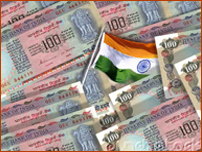 |
The
Indian Rupee is appreciating fast. And this rise
is affecting many sectors in good or bad ways.
Take a quick look on the effect of the rising
rupee on various industries;
Rising rupee hits small exporters;
Small exporters are especially facing the brunt
here. Unlike large exporters, these people do
not have any financial reserves to fall back on.
As they depend on local raw material, they do
not see any benefits from imports becoming cheaper
with the rise of the rupee. |
|
|
| The
chairman of Apparel Export Promotion Council, Mr. Vijay Aggarwal
has said that if the rupee continues to strengthen, at least
30 to 40 textile units in the apparel sector stand a chance
of closing down. On its part, the commerce ministry has decided
to compensate the losses recurred by the exporters by cutting
the premium charges by the Export Credit Guarantee Corporation,
enhancing the DEPB (Duty Entitlement Pass Book scheme) and
duty drawbacks and making earners foreign currency (EEFC)
accounts for interest bearing. But exporters are still facing
a tough time as many of them do not have an EEFC account and
are not eligible for DEPB and drawbacks on the products that
they export. Hence these people can breathe a sigh of relief
only when the Rupee weakens.
IT sector faces a blow;
The rising rupee has only added more trouble
to the woes of the Indian IT industry which is already facing
the burden of the rising costs of the Indian IT industry which
is already losing out on account of the wage increases, high
attrition and over- dependence on the U.S. market for business.
Market analysts are of the view that with earnings round the
corner, IT stocks are poised on the bottomline if the rupee
appreciates further against dollar.
Gross Domestic Product (GDP);
Since 1991, India’s peak import duty
has come down to 30 per cent. Though still high by global
standards, this means that Indian prices are much closer to
global ones. So GDP has become more real and less illusory.
However it is a matter of interest that the rupee has strengthened
from Rs 49 to Rs 45.30 to the dollar over the last year, and
forex reserves have crossed $90 billion. Exports of goods
and services are booming, and dollars from both NRIs and foreign
investors are cascading in. If GDP rises 5.8 per cent and
the rupee appreciates 2 per cent annually, that will represent
a growth of 7.8 per cent in dollar terms. This in turn could
lead to a miraculous economy growth.
Forex;
Flows and stock markets are presently strong
while the dollar still stands weak in comparison to the Indian
rupee. The positive factors are strong enough to lower the
persistent rise in crude oil prices. Forward premia has fallen
sharply while the rupee is being appreciated. Traders are
however taking advantage of the situation of the lower levels
to pay later.
NRI’s;
It is being observed that Indians working
abroad have been badly hit by the rise in rupee. The rupee
appreciation is eroding their savings.
Asia coming in terms with rising rupee;
Inspite of the Indian rupee not being acceptable
in the international money market, it is being widely accepted
due to growing trade and an increase in tourist inflows. There
is speculation that several hotels might very soon do away
with the dual tariff structure and offer a single rupee tariff.
This will put foreign tourists and Indians in the same boat.
According to recent reports the Indian rupee is being widely
accepted in hotels in Singapore, Malaysia, Indonesia, Hong
Kong, Sri Lanka and many more Asian countries, which are willing
to accept the currency due to its strengthening against the
dollar.
|
| Top |
|
| |
| |
Please
do not reply back to this mail. This is sent from an unattended
mail box.
Please mark all your queries / responses to webmaster@insuregain.com |
|
| |
Information provided on this newsletter
has been independently obtained from sources believed to be
reliable. However, such information may include inaccuracies,
errors or omissions. www.insuregain.com and its affiliates,
information providers or content providers, shall have no
liability to you or third parties for the accuracy, completeness,
timeliness or correct sequencing of information available
on this newsletter, or for any decision made or action taken
by you in reliance upon such information, or for the delay
or interruption of such information. www.insuregain.com, its
affiliates, information providers and content providers shall
have no liability for investment decisions or other actions
taken or made by you based on the information provided on
this newsletter.
|
|
|
|