|
|||
 The
Emergence of Micro Insurance in India The
Emergence of Micro Insurance in IndiaLast September LIC announced its foray into the field of micro insurance, with the aim of extending insurance cover at the grass root levels. Jeevan Madhur, launched by President A.P.J. Abdul Kalam himself, is their first policy in the field. Now in the first week of April LIC, within 6 months of launching the policy, LIC has collaborated with 3i Infotech to transact micro insurance business on LIC's behalf. 3i Infotech is a global IT services and solution provider and 4th largest software product company in India. It is going to help Micro Insurance Agents, NGOs, Self Help Groups and Micro Finance Institutions to do business in online and offline modes. The noble gesture with which LIC has forayed into the field is to provide insurance cover exclusively for low income groups and those who don't have a stable income. The policy is flexible in terms of amount and timeline of premium to be paid and in terms of giving maturity benefits. The software products will enable the Micro Insurance Agents to completely manage their insurance portfolio and provide them with reporting capabilities. Additionally the software will facilitate information exchange with LIC’s systems and be a desktop-based full fledged application with local repositories of information pertaining to Micro Insurance Agents. Overall, the system will provide LIC with greater control over its Micro Insurance practice, by enabling a closer interaction with its agents in online and offline modes. The news is big for agents wanting to delve into the Micro Insurance field as it has a huge potential size lying untapped. LIC is anticipating sales of over 1 crore policies within a period of two to three years. And this being a first of its kind initiative, it is going to be the most popular one in the coming years, in rural and semi-urban India. With the penetration of insurance being only about 2% in rural areas millions of people remain to be covered. This provides an unbound potential to not just LIC but to the insurance agents also. Jeevan Madhur, launched by President APJ Abdul Kalam in September last year, has succeeded in extending insurance coverage of Rs 110 crore to 80,637 economically underprivileged people in the society.
|
|||
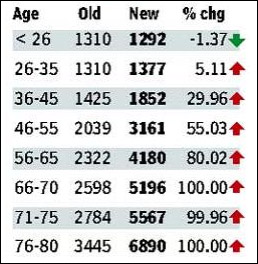
 Mediclaim Price Hike – Whats and Whys? Recently Mediclaim's premium was increased by 30-100%, making insurance against hospitalization as well as post-hospitalization treatment costlier to avail. Putting an upper cap on expenditure on policyholders’ part has also reduced policy’s coverage. An upper limit on the payments of all types of hospital charges is also set. The only saving grace is the fact that people below 26 years of age will be charged less than what they have to pay now. Another change is the lucrative looking 6% discount a policyholder would get if he pays his bills upfront and seek a reimbursement later, instead of availing cashless hospitalization. Mediclaim is thus being renewed and is being presented in new overalls. This has left many people puzzled and disappointed. Here are the internals of the whole issue. Claim Ratio is the amount companies pay for each 100 rupees they collect as premiums. While it was 70-80% in 2002, the claim ratio has increased upto 130-140% in early 2007, thanks to increasing healthcare prices. On the other hand, the insurance companies have not revised the prices since past 9 years. This means for every Rs. 100 insurance companies earn as premium, they have to dish out Rs. 130-140 for claims, which obviously have led to losses running into crores. The reason for this imbalance is larger proportion of middle aged and older people buying the policies. In India lack of awareness makes people conscious of the need to get a health insurance policy only by the age of about 40 or 45 years of age. Whereas not many youths go for health insurance covers. This creates a discrepancy and leads to adverse selection for the insurer. After years of operation, a majority of private players are yet to break-even in their health cover portfolio. The change in annual premiums is summarized in the figure below:
Also room rents in nursing homes/hospitals have been capped at 1 per cent per diem of the sum insured, subject to a maximum of Rs. 5,000. ICU charges have been fixed at 2 per cent per diem, subject to a maximum of Rs. 10,000 a day. The overall limit under this head is 25 per cent of the sum insured per illness. While a cap of 25 per cent of the sum insured has been placed on consultancy and surgeon charges, a sub-limit of 50 per cent has been fixed for other categories like blood, OT, and drugs. National Insurance has introduced an ambulance charge of 1 per cent of the sum insured up to a maximum of Rs. 1,000 for the first time as well.
|
|||
 Trading
of Life Insurance Policies Trading
of Life Insurance PoliciesRecently Bombay High Court upheld the rights of companies and individuals to trade life insurance policies to anyone they want. Though legally it was never restricted but the life insurers (essentially LIC) discouraged it by themselves. Conventionally trading was only allowed with an entity that had some insurable interest for the policyholder - like with a bank, as security for loan. But in cases of emergencies life insurance policy can be sold for a higher price than what is offered by insurers for lapsed policy. After selling, if the policyholder dies, his death benefit goes to the buyer, instead of the beneficiary. Thus, free trading goes against the principle of insurable interest, and that's why LIC didn't allow policy trading. IRDA has also been of the same opinion hence recent private players also followed the same norm. But recently with increased number of lapsed policies, it is the policyholder who stands to lose the money paid as premiums. Trading help them get some money for their lapsed policies. A crore life insurance policies with a total sum assured value of Rs 74,076 crore lapsed in 2005-06. Insure Policy Plus Services (IPPS India) is the company that specializes in trading in lapsed insurance policies. Company or individuals interested in buying, contact agents for details of individuals who have bought insurance products with guaranteed returns, but failed to pay the premium on time. Next, the individual is offered a better deal that the "surrender value" he/she would get from the insurance company. At times, the surrender value may be less than the total premiums paid, hence the policyholders usually agree for a trade. The company or individual who bought the policy will renew the policy and pay the premium for the remaining term. On maturity of the policy, the new owner would get the insured amount plus bonus, tax-free. Trader gets maturity amount, the original policyholder gets a higher sum and the agent gets renewal commission, making it a win-win situation for everyone. But the moral hazard associated with policy trading led LIC to challenge policy trading. On being approached by a private trading company, the Court ruled that Insurance Act does not forbid policy trading and hence LIC cannot stop it. But apart from moral hazard of people trading policies and killing the original holder to get benefits, there is another problem of keeping track of the policy upon its entry in the secondary market where insurable interest is not present. For the same reason insurers are arguing now about having better regulations rather than restrictions for trading, to prevent misrepresentation and fraud. More than the type of the policy, what is more important is the reason behind selling the policy. Also, a need for pricing mechanism is being felt to ensures fairness to both policyholders and buyers. In developed countries, there’s an active secondary market in insurance policies, operating under guidelines for brokers and policyholders.
|
|||
 Insurance
Blues for Elders Insurance
Blues for EldersInsurance companies are raising their premium rates for senior citizens by almost 100 per cent, forcing them to either discontinue their medical insurance plans or reduce the sum assured. This has made difficult for our elders to seek insurance cover or health cover. With the claim ratio going up the insurance companies are paying more than they are earning, thereby forced to hike up the prices of their services/products. Finding a way out for old people is difficult but these following rough guidelines would be of interest to everyone affected by the changing market scenarios. Group insurance schemes and mediclaim policies are always offered at a lower premium than individual policies. And now that banks have forayed into the field of insurance, many public sector banks are offering some kind of insurance cover to their account holders. These policies are invariably low cost ones. People until the age of about 60 can avail such offers. Senior citizens who already have policies but who have not availed any claim money, can take advantage of the accrued non-claim bonus and reduce the level of sum assured to keep their premium outgo at the previous level. Insurance companies increase your sum assured by 5 per cent for every no-claim year. Keeping a tab on the market for new schemes for the elderly would be good. Like Silver Health by Bajaj Allianz was launched exclusively for elderly people. It is also suggested that elderly individuals could take their health cover as part of a package for the entire family, which is cheaper. Many companies also allow their retired employees to continue the group health covers they availed during their tenure in the company. Though they have to pay the premiums post-retirement but these would be in the lower range since the policies were bought as group policies. On being approached if a company refuses the insurance cover, they can be cross-questioned and the matter can be reported to IRDA. Insurance agents can be the best guides in such cases.
|
|||
| Please
do not reply back to this mail. This is sent from an unattended mail
box. Please mark all your queries / responses to webmaster@insuregain.com |
|||
|